Profile
Each summer, the quiet coastal settlement of Waipū transforms into something extraordinary. The Highland Games bring up to 8,000 people to this small Northland town for a day of piping, drumming, highland dancing and heavyweight competitions that have run continuously for over 150 years. It’s one of the Southern Hemisphere’s longest-running Scottish gatherings, and it happens because Scottish settlers who founded Waipū in the 1850s were determined to maintain their heritage in their new home.
The games aren’t a tourist attraction that someone invented to draw visitors. They emerged from the community itself, starting in 1871 when early settlers formed the Caledonian Society to support late arrivals from Nova Scotia and preserve Scottish culture through regular gatherings. Those early picnic days where settlers competed in dancing and athletic events evolved into the formal Highland Games that now draw competitors from across New Zealand and occasionally from overseas.
Walking into Caledonian Park on games day, you see the full spectrum of Scottish tradition. Pipe bands tune their instruments. Highland dancers stretch and prepare. Heavyweight athletes warm up for caber tosses and hammer throws. Clan representatives arrange their tartans. Families spread picnic blankets. Food stalls set up. It’s controlled chaos that somehow organizes itself into a day-long celebration running from the morning street march through to late afternoon competitions.
The Day Begins
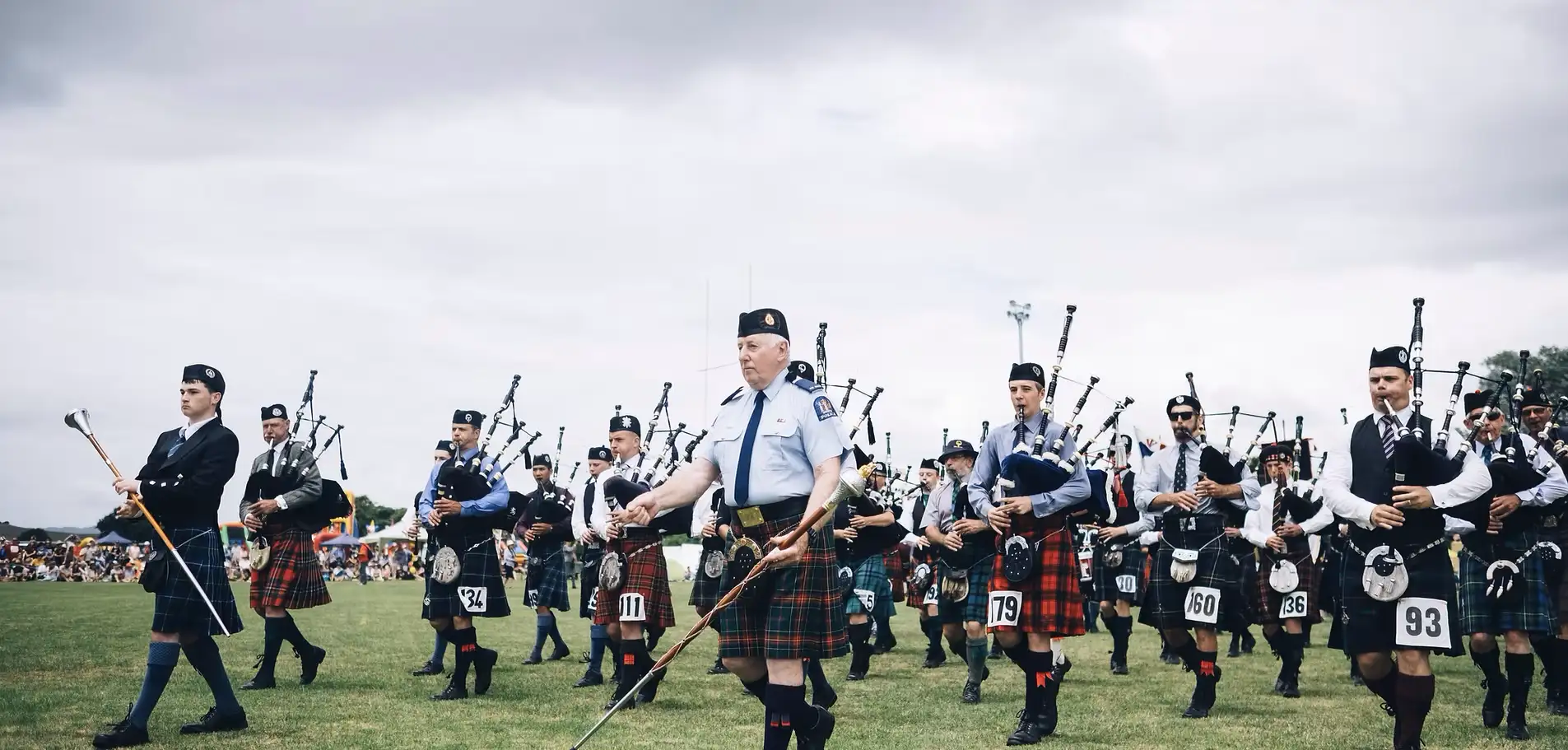
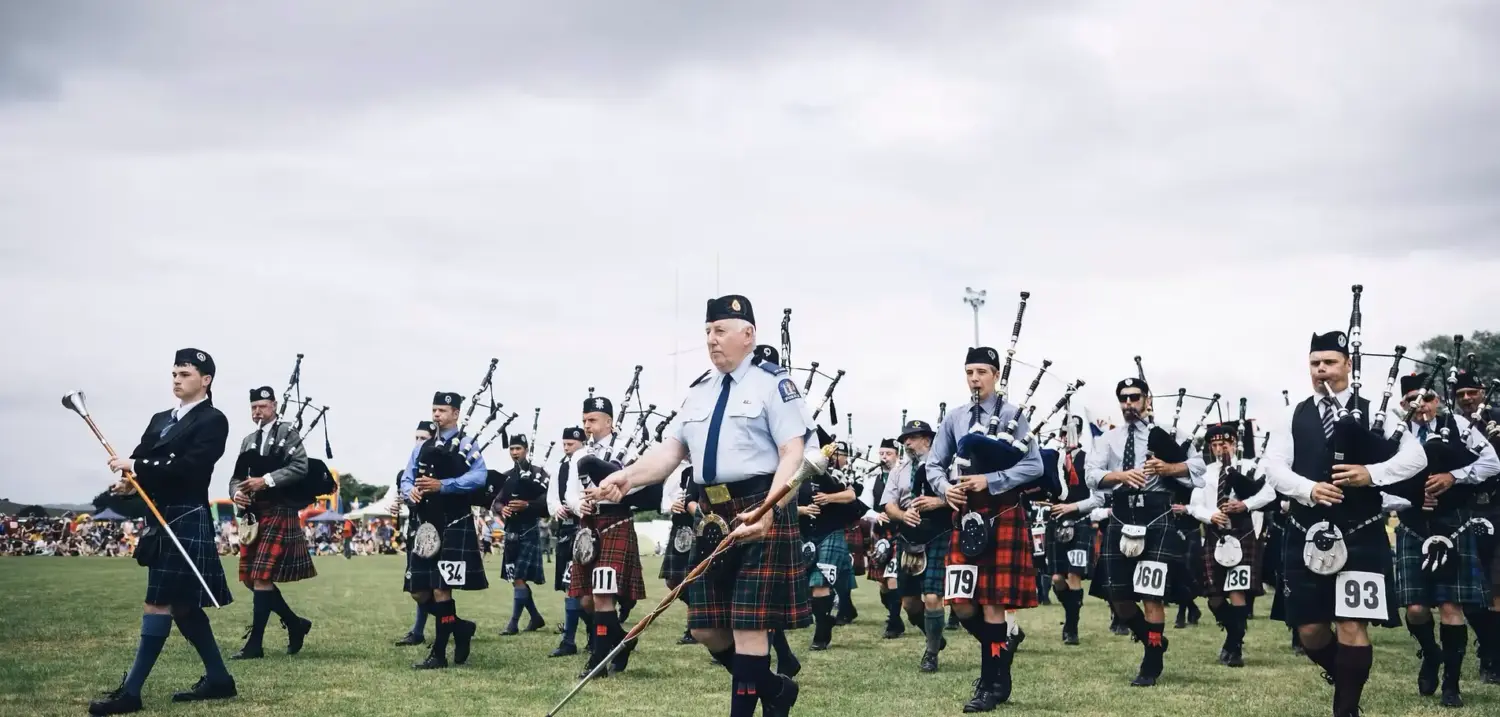
The street march kicks off the formal programme. Pipe bands assemble at the monuments in central Waipū, the sound of tuning drones echoing between buildings. Clans gather alongside them, tartans creating vivid displays as representatives of Scottish family names prepare to march. When the procession moves through Waipū’s streets, the pipes echo off buildings and the community lines the route to watch. It’s a connection to the town’s founding, when early settlers would have marched similar routes celebrating their heritage.
The grand entry into Caledonian Park follows, with bands and clans performing the official salute outside the Celtic Barn. This formal opening contrasts with the relaxed atmosphere that develops as the day progresses, but it establishes the significance of what’s being celebrated. For many spectators, the street march and grand entry represent highlights. The concentrated pageantry defines Highland Games in ways that individual competitions, while impressive, don’t quite match.
Around lunchtime, massed bands return to the main arena. Multiple pipe bands join together, creating a wall of sound that resonates across the park. The mass Highland Fling follows, with dancers from various competitions gathering to perform in unison. These collective performances demonstrate community aspect alongside individual competition. Everyone comes together in shared celebration of their art.
Competition and Tradition
Highland dancing competitions run across two stages, with dancers competing in categories based on age and skill level. The Scottish Official Board oversees Highland dancing standards, maintaining connections between New Zealand competitions and Scottish traditions. Dancers perform the classic Highland dances: the Highland Fling, Sword Dance, Seann Triubhas and Reel of Tulloch. The movements are precise and energetic, requiring technical skill and stamina. Watching young dancers master these demanding forms shows how traditions pass to new generations.
National dancing competitions run alongside Highland events, broadening the programme while maintaining focus on Scottish dance traditions. The variety means spectators see different styles and approaches throughout the day, preventing monotony despite hours of competition.
Solo piping and drumming competitions begin early and continue through much of the day. Competitors perform in various categories based on experience level. The Helen McGregor Memorial Medley, held the evening before the main games, represents a unique piping event unlike any other in New Zealand. Elite pipers perform freestyle interpretations that blend traditional technique with innovation. During the games themselves, pipers compete in separate events covering different musical forms: marches, strathspeys, reels and jigs. Each tests different aspects of skill and musicality.
Drumming competitions run parallel to piping, showcasing the percussive artistry underpinning pipe band performances. Fiddling competitions provide musical variety, with competitors performing Scottish traditional music. The Coronation Hall hosts these events, offering acoustic intimacy suiting the violin’s character. Winners demonstrate mastery of Scottish fiddle traditions while bringing individual interpretation to familiar tunes.
The Heavyweight Arena
Heavyweight competitions draw substantial crowds to the main arena. These events test raw strength, technique and endurance, with roots in Highland warrior traditions and agricultural practice. Watching athletes compete in traditional Scottish field events creates some of the day’s most dramatic moments.
The New Zealand Open Heavyweight Competition attracts the country’s top athletes. Events include the caber toss, hammer throw, weight for distance and stone put. The caber (a tapered pole measuring nearly 5.5 meters and weighing 58 kilograms) represents the iconic Highland Games event. Competitors must flip it end over end, with scoring based on straightness rather than distance. Watching athletes struggle to control the unwieldy timber as they build momentum before the toss captivates audiences every time.
Hammer throwing involves spinning a weighted ball on a shaft, building rotational speed before release. Weight for distance tests pure throwing power. Stone putting echoes shot put but uses rounded stones of various weights, connecting the competition to times when farmers tested strength using whatever materials were at hand.
Junior and senior novice heavyweight events provide opportunities for developing athletes and those new to the disciplines. These competitions introduce broader participation while maintaining competitive character. Seeing young athletes attempt their first caber toss or learn proper hammer technique demonstrates how traditions continue passing forward.
Family Participation
While serious competition defines much of the day, the Highland Games maintain strong family appeal through events designed specifically for children and community participation. Kids’ running races attract large fields of young competitors, with parents crowding track edges to cheer. Races are organized by age group, ensuring fair competition while giving every child their moment.
Tug of War competitions in Arena 2 bring adults and children together in team events testing collective strength and coordination. Teams register on the day, with competitions running through the afternoon. The simplicity of tug of war (pure team effort pulling against another team) creates accessible participation drawing both serious competitors and groups of friends looking for fun challenge.
A kids’ zone provides activities and entertainment for younger children, ensuring families can spend the full day without children becoming restless. Various stalls and activities scatter throughout the park, from Tartan in the Park competitions where people of all ages participate in Scottish-themed activities to clan tents where families explore genealogy and heritage connections.
Waipū’s Founding Story
The Highland Games carry additional significance because of Waipū’s distinctive founding. In the 1850s, over 800 followers of Reverend Norman McLeod made the journey to New Zealand after previously settling in Nova Scotia. These Scottish emigrants had left Scotland during the Highland Clearances, establishing a new community in Canada before hardship led McLeod to seek yet another new home. When they arrived in Waipū, they brought cultural traditions, language and determination to maintain Scottish identity.
The Caledonian Society formed in 1871 to support late arrivals from Nova Scotia and preserve Scottish culture through regular gatherings. The Highland Games emerged from these early community picnic days. The continuity from those first gatherings to modern games represents an unbroken tradition spanning over 150 years, making Waipū’s Highland Games one of the oldest continuous Scottish cultural celebrations outside Scotland itself.
The Waipū Museum, located near the games venue, provides context for visitors wanting to understand the town’s history. Exhibits detail the remarkable journey from Scotland to Nova Scotia to New Zealand, showing how this small community maintained cohesion across decades and thousands of miles. Visiting the museum before or after the games deepens appreciation for what the event represents: not just entertainment, but living connection to a founding community’s heritage and determination.
The Evening Celebration
The Ceilidh/Hogmanay celebration extends the Highland Games into the evening, transforming the Celtic Barn into a venue for traditional Scottish dance and music. This ticketed event attracts both games attendees wanting to continue the celebration and those specifically interested in evening programming. Ceilidh dancing (social dancing where caller instructions guide participants through traditional Scottish dances) creates inclusive atmosphere where experienced dancers and complete beginners join in together.
Live bands provide music for the ceilidh, maintaining energy through hours of dancing. Traditional tunes combined with contemporary energy create celebrations honoring heritage while remaining thoroughly enjoyable for modern participants. As the evening progresses toward midnight, Hogmanay (Scottish New Year) tradition takes center stage, with crowds counting down and celebrating the year’s arrival in Scottish style.
For those attending both day’s games and evening ceilidh, it represents complete immersion in Scottish celebration. From morning’s formal competitions through afternoon’s family activities to evening’s social dancing and midnight festivities, the two events complement each other, offering different facets of Scottish culture and different ways to participate.
The Spectator Experience
Attending as a spectator provides flexibility in experiencing the day. Multiple simultaneous competitions mean choosing between watching elite pipers compete, observing highland dancers or positioning yourself near the heavyweight arena for dramatic caber tosses. Many spectators move between different areas as the day progresses, sampling various competitions while seeking shade during hot summer weather.
Food and refreshment stalls operate throughout the park, often run by local community groups as fundraisers. Traditional Scottish food appears alongside standard event fare, allowing curious visitors to sample haggis or other dishes while supporting local causes. The variety ensures everyone finds suitable options regardless of dietary preferences.
The atmosphere combines serious competition with community celebration. While competitors focus intensely on performances and judges deliberate carefully over results, spectators maintain relaxed holiday mood. Families spread picnic blankets, groups of friends compare notes on performances and children run between events soaking up festival atmosphere. This balance between competitive excellence and community enjoyment defines the games’ character.
Planning Your Visit
The Highland Games attract large crowds, with several thousand spectators attending. Arriving early provides better parking options and allows time to find good viewing positions before major events begin. Tickets are available online in advance through TryBooking, with early purchase recommended to avoid potential gate delays.
Parking is available around Waipū township, with free parking provided in designated areas. The compact nature of Waipū means even distant parking remains within reasonable walking distance of Caledonian Park. However, the small town’s infrastructure faces pressure on games day, so patience and planning help.
Summer weather in Northland can be hot, with little natural shade in some competition areas. Bringing sun protection (hats, sunscreen and water bottles) ensures comfort through a long day outdoors. Comfortable seating or blankets allow flexibility in viewing locations, while many areas have bench seating near competition stages.
The games operate a strict no-dogs policy due to health, safety and logistical considerations. This applies even to well-behaved pets, so planning alternative care ensures compliance.
For those wanting to make a weekend of their visit, Waipū offers accommodation ranging from camping to motels, though booking well in advance is essential for games weekend. The nearby coast provides beautiful beaches for pre or post-games relaxation, while the town itself offers cafes, restaurants and the Waipū Museum for fuller exploration.
A Living Tradition
The Highland Games survive and thrive because of committed volunteers and community support. The Caledonian Society relies on members dedicating time to organizing, running competitions, managing logistics and ensuring the event maintains quality and character. Local businesses sponsor various aspects, recognizing both economic benefit of attracting thousands of visitors and cultural value of preserving this heritage celebration.
For competitors, Waipū represents an important fixture on competitive calendars. Pipers, drummers, dancers and heavyweight athletes mark the games as essential events where they test themselves against strong competition while being part of an event with genuine historical significance. The prestige associated with winning at Waipū reflects the games’ long-standing reputation for high standards.
The event demonstrates how immigrant communities maintain cultural connections across generations and vast distances. Scottish settlers who founded Waipū could scarcely have imagined their Highland Games would still be drawing thousands of spectators over 150 years later, but their determination to preserve heritage created something resonating beyond their own community. The games now welcome all visitors regardless of Scottish heritage, making the celebration accessible while maintaining authenticity.
Experience Scotland in Northland
The Highland Games offer a chance to experience Scottish tradition in an unexpected setting, a small coastal town in northern New Zealand. The combination of serious athletic and artistic competition with family-friendly atmosphere and community celebration creates an event working on multiple levels. Whether watching world-class piping, witnessing the drama of heavyweight competitions, introducing children to Scottish culture or simply soaking up festival atmosphere, the games provide compelling reasons to visit Waipū.
The day represents more than entertainment. It’s living connection to the town’s founding story, a celebration of cultural heritage maintained across hemispheres and centuries, and demonstration of how small communities sustain significant traditions through collective commitment. Attending the Highland Games places you within this continuing story, participating in a New Year celebration honoring the past while creating new memories.
For full event details, ticket information, competition schedules and updates, visit the Waipū Highland Games website.
Map
Sorry, no records were found. Please adjust your search criteria and try again.
Sorry, unable to load the Maps API.